Google Ads Campaign Structure: Best Practices In 2025

In 2025, you’ll need to structure your Google Ads campaigns around AI-driven optimization while maintaining strategic control. Focus on Performance Max campaigns for broad reach, and organize single-product ad groups for precise targeting. Smart bidding strategies are essential, with automated bid adjustments helping you maintain competitive CPCs around $4.66. Implement a robust negative keywordThis is the term or phrase that users utilize to search for anything on the internet. This can also be the term focused on by SEO experts to drive organic traffic to their website. strategy across account, campaign, and ad group levels to prevent waste. Your ad copy should feature emotional triggers and clear CTAs, while leveraging custom segments and search themes for enhanced targeting. The shift from Video Action to Demand Gen campaigns promises 20% higher conversions – and that’s just the beginning of what’s possible.
Core Campaign Types
Display campaigns help you connect with potential customers across millions of websites and apps using visually engaging ads. You’ll benefit from powerful retargeting options and multi-format capabilities that keep your brand top of mind. Google’s evolving keyword strategy emphasizes contextual targeting signals rather than traditional keyword matching.
Video Action campaigns are evolving to Demand Gen by Q2 2025, expanding your reach beyond YouTube to include Discover and Gmail. Starting March 2025, no new Video Action campaigns can be created. Internal data shows 20% higher conversions with Demand Gen compared to traditional campaigns. You’ll have access to video, image, and carousel formats, with Google’s AI optimizing placements automatically.
Performance Max campaigns represent the most all-encompassing option, giving you access to all Google Ads inventory through a single, AI-powered campaign. You’ll maximize conversions across channels while simplifying campaign management.
App campaigns focus specifically on mobile app promotion, driving installs and engagement. They’re easy to set up and leverage Google’s AI to optimize performance across Search, Display, Play, and YouTube, making them ideal for app marketers.
Struggling With Google Ads Affiliate Campaigns?
Get instant access to the most comprehensive Google Ads affiliate marketingAffiliate marketing is a performance-based online marketing strategy where businesses (often called merchants or advertisers) reward individual marketers (known as affiliates or publishers) for driving traffic, leads, or sales to the business’s products or services. In this model, affiliates earn a commission for each agreed-upon action completed by a referred customer. Key aspects of affiliate […] course available. Learn from a $7M affiliate who reveals everything – from setup to scaling.
Single Product Ad Groups
Single Product Ad Groups (SPAGs) represent a strategic approach to campaign segmentation where each ad group focuses exclusively on one product or SKU. This highly targeted structure guarantees your ad copy and keywords perfectly align with specific products, leading to improved relevance and higher quality scores.
When you’re implementing SPAGs, you’ll notice several key advantages, though they do come with certain challenges. The primary benefit is the ability to create laser-focused campaigns that match user intent, ultimately driving better conversionThe completion of a desired action by a user# such as a purchase# sign-up# or download. Conversions are the ultimate goal of most marketing campaigns and serve as a key metric for measuring success. rates and reduced cost per acquisition.
- Create unique ad groups for each product variation to maintain targeting precision
- Implement specific, long-tail keywords that directly relate to your product
- Monitor performance metricsKey performance indicators used to measure the success of affiliate marketing efforts, such as conversion rate, EPC, and ROI. closely to optimize bids and budget allocation
- Develop highly relevant ad copy that speaks directly to the product features
- Regularly review and adjust your campaign structure based on performance data
While SPAGs require more initial setup time and ongoing management, the enhanced control and optimization capabilities make them worth considering for most advertisers.
You’ll need to balance the complexity of managing multiple ad groups against the potential performance improvements, especially if you’re working with a large product catalog.
Bidding Strategy Fundamentals
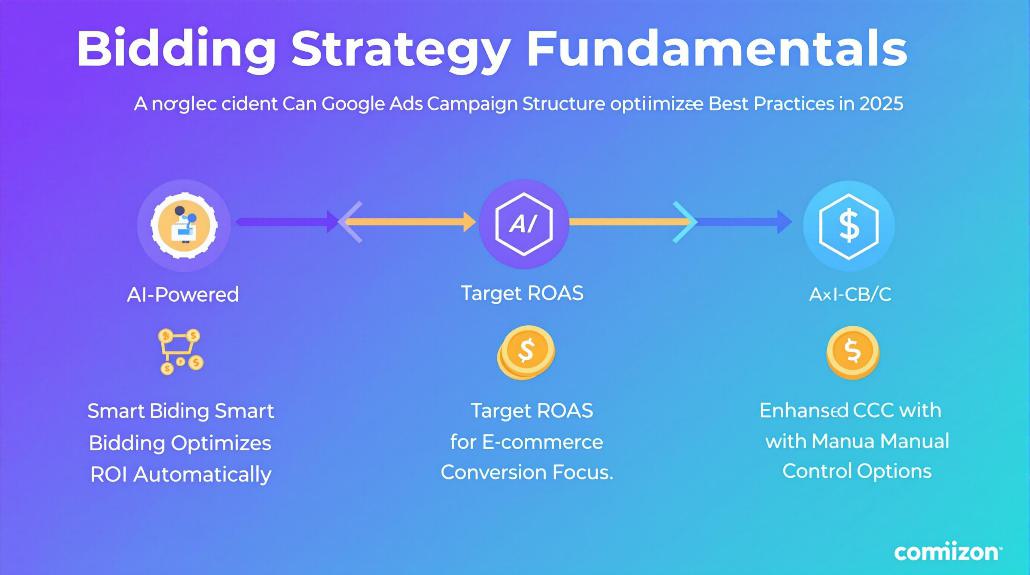
You’ll want to start by understanding how CPC tiers work across your campaign structure, with higher bids typically needed for more competitive keywords and audience segments.
Smart Bidding automation lets you leverage Google’s machine learning to optimize bids across different segments while maintaining your target CPA or ROAS goals.
Understanding CPC Tiers
Cost-per-click (CPC) tiers form the backbone of Google Ads’ bidding system, determining how much you’ll pay for each click and where your ads will appear in search results.
With the upcoming sunset of Enhanced CPC in March 2025, you’ll need to understand how different CPC tiers affect your campaign scaling and overall performance. Starting October 2024, new campaigns will not support eCPC bidding.
When managing your CPC tiers, consider these essential elements for successful campaign management:
- Monitor your actual CPC versus max CPC bid to guarantee efficient spend allocation
- Align your bidding strategyA plan for determining how much to bid for ad placements in pay-per-click advertising campaigns. with specific business goals and conversion targets
- Review industry
The current average CPC across Google Ads stands at $4.66 per click, representing a 10% increase from previous benchmarks.
Advertisers should consider transitioning to Maximize conversions bidding as a viable alternative for optimizing campaign performance.
Smart Bidding Automation Strategy
Google’s Smart Bidding automation represents a fundamental shift in how advertisers approach bid management, leveraging machine learning algorithms to optimize bids across multiple dimensions. Within your campaign hierarchy, this system analyzes vast amounts of data to predict conversion likelihood and adjust bids in real-time.
You’ll find that Smart Bidding integrates seamlessly with your existing Google Ads tools, working alongside Google Analytics, Search Ads 360, and Google Merchant Center to enhance performance. This integration enables you to:
- Set clear performance goals based on CPA or ROAS
- Automate bid adjustments across locations, devices, and time
- Track conversion actions and value metrics efficiently
- Adapt to market changes without manual intervention
The system’s machine learning capabilities mean you won’t need to spend time making manual bid adjustments. Instead, you can focus on strategic decisions while the algorithm:
- Processes real-time auction data
- Evaluates user signals and intent
- Optimizes bids for specific conversion actions
- Adjusts strategy based on performance patterns
Strategic Keyword Organization
Your success with Google Ads campaigns depends heavily on choosing the right match types for your keywords and implementing them strategically.
You’ll want to start with broad match modified and phrase match to capture relevant trafficThis is the inflow of visitors to a page. while maintaining control, then adjust based on performance data.
A robust negative keyword strategy isn’t optional – it’s essential for preventing wasted spend and ensuring your ads show up for the most qualified searches.
Match Types Matter Most
Match type selection serves as the cornerstone of effective keyword organization in Performance Max campaigns.
When you’re developing your keyword matching strategy, you’ll need to balance reach with precision to maximize your campaign’s effectiveness.
Here’s what you need to know about match types and their impact on your campaigns:
- Broad match gives you the widest reach, letting you capture related searches and synonyms – perfect when you want to discover new converting keywords.
- Phrase match offers a middle-ground approach, maintaining relevance while still capturing valuable variations of your target phrases.
- Exact match provides the highest precision, ideal for bottom-funnel conversions and brand-specific terms.
- Combining match types strategically helps you create a thorough coverage model.
- Regular monitoring and adjustment of match types guarantees peak performance as search behaviors evolve.
You’ll want to start with a mix of match types, then refine based on performance data.
For example, use broad match to identify valuable search terms, then add high-performing phrases as exact match keywords.
This layered approach helps you maintain control while leveraging automation effectively.
Negative Keywords Drive Success
While match types help you target the right searches, negative keywords play an equally important role by protecting your campaigns from irrelevant traffic. By strategically implementing negative keywords, you’ll guarantee your ads appear only for searches that align with your business goals and target audience.
To drive success with negative keywords, you’ll want to:
- Review search terms reports regularly to identify irrelevant queries
- Apply negative keywords at account, campaign, or ad group levels
- Group negative keywords by themes for better organization
- Use different match types strategically to refine targeting
Remember, negative keywords drive success by improving your campaign’s efficiency in multiple ways. They help reduce wasted ad spend, enhance ad relevance, and protect your brand from unwanted associations. Incorporating negative keywords can prevent your cost-per-click from inflating to $5 or more. Machine learning algorithms now help prioritize negative keywords based on their potential impact on campaign performance.
You’ll see improved click-throughThe user action of clicking on an advertisement or hyperlink and successfully loading the destination page. This metric is fundamental in assessing the initial effectiveness of ad creatives and promotional content. rates and conversion rates as your ads reach users with genuine purchase intent. These improvements can leadThis is a type of conversion wherein the user only needs to submit specific information for the conversion to be considered. Businesses use such leads to get in touch with potential customers. to better ROAS through more precise targeting.
Start small with your negative keyword strategy and build gradually. Make it a habit to review and update your negative keyword lists regularly, using data from search terms reports and keyword researchThis is the technique that search engine experts use when finding terms to base their content on to increase their website’s search engine rankings. tools to inform your decisions.
This ongoing optimization will help maintain strong campaign performance over time.
Quality Score Optimization
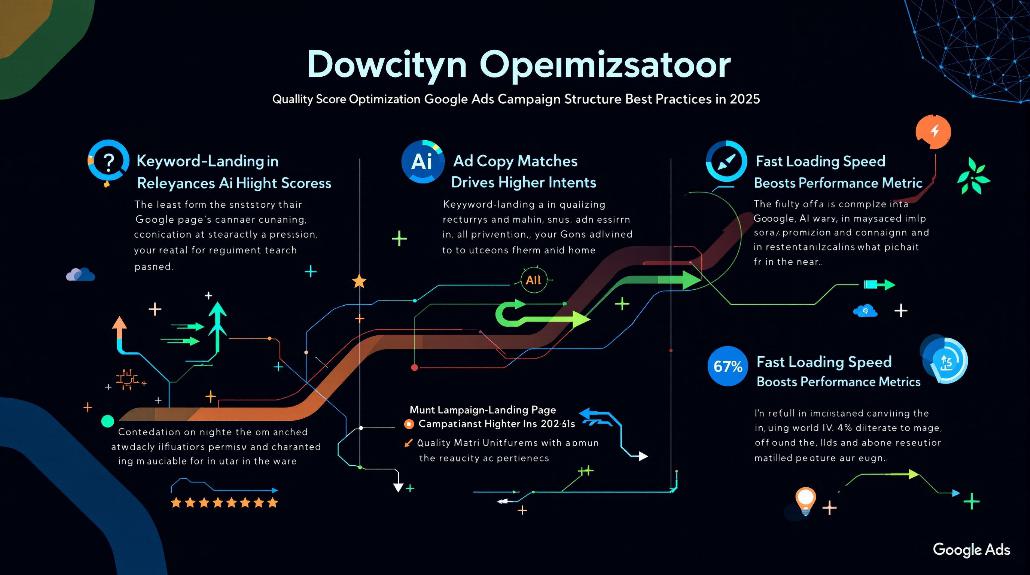
Understanding Quality Score is vital for maximizing your Google Ads campaign performance. This significant metric, scored from 1-10, directly impacts your ad rank and costs, making it a key factor in your campaign’s success. You can achieve immediate results with precise targeting to drive traffic instantly.
By focusing on quality score optimization, you’ll improve your ad visibility while reducing costs. With 76% of budgets wasted on ineffective campaigns, maintaining a strong Quality Score is crucial for success. The three components of ad relevance, CTR, and landing page work together to determine your final score.
To boost your Quality Score, you’ll need to align your ads, keywords, and landing pages while maintaining consistent performance monitoring. Remember that higher scores lead to better ad positions and lower costs per click, making optimization efforts well worth your investment.
Here are the key components you should focus on to improve your Quality Score:
- Create highly relevant ad copy that matches search intent and landing page content
- Optimize landing pages for fast load times and engaging user experience
- Regularly audit and refine keyword targeting to guarantee alignment with ad messaging
- Implement proper audience segmentation across demographics and locations
- Monitor and adjust campaigns based on Quality Score feedback
Campaign Budget Management
Your daily spend optimization in Google Ads starts with setting the right campaign budgets and monitoring their performance across your account.
To maximize your return on investment, you’ll want to distribute your budget strategically across campaigns based on their historical performance data and alignment with business goals.
Consider implementing the 70-20-10 rule when allocating your advertising budget across campaigns.
You can leverage shared budgets to efficiently manage spend across multiple campaigns while maintaining flexibility to adjust allocations based on real-time performance metrics.
Setting up automated budget rules can help monitor and adjust campaign spending automatically based on performance metrics.
Daily Spend Optimization
Three critical components drive successful daily spend enhancement in Google Ads: budget allocation, smart bidding strategies, and continuous monitoring.
You’ll need to calculate your daily budgetThe maximum amount an advertiser is willing to spend per day on a specific campaign or ad set. This budgeting tool helps control advertising costs and paces campaign spending over time. by dividing your monthly budget by 30.4, keeping in mind that Google may spend up to twice your daily budget on any given day while maintaining monthly limits.
To maximize your daily spend effectiveness, implement these essential strategies:
- Set up shared budgets across multiple campaigns to simplify management
- Use smart bidding strategies like Target CPA or ROAS to automate enhancement
- Monitor performance metrics daily and adjust allocation accordingly
- Conduct regular 4-6 week testing periods to gather performance data
- Leverage AI tools for automated budget adjustments
For peak performance monitoring, you’ll want to focus on key metrics like ROAS and CPA while maintaining flexibility in your approach.
If you’re running multiple campaigns, consider using shared budgets to streamline management and allow for dynamic allocation based on performance.
Remember to regularly analyze your campaign results and reallocate unspent budget to top-performing campaigns or save it for future use.
Budget Allocation Strategy
Mastering budget allocation in Google Ads requires a strategic balance of proven tactics and experimental approaches. You’ll want to follow the 70-20-10 rule: dedicate 70% of your budget to proven strategies, 20% to promising new initiatives, and 10% to experimental campaigns.
To optimize your budget effectively, consider implementing these budget optimization techniques:
- Create shared budgets to streamline management across multiple campaigns
- Monitor ROIReturn on Investment, a key performance indicator calculated as a percentage by dividing profit by cost and multiplying by 100. and ROAS metrics weekly to adjust allocations
- Focus spending on campaigns with high conversion rates
- Align landing pages with ad messaging to improve performance
Common pitfalls to avoid:
- Setting unrealistic ROAS targets without sufficient data
- Implementing overly aggressive CPA goals
- Neglecting regular campaign optimization
- Failing to test ad variations consistently
For best results, you’ll need to regularly audit your campaigns and make data-driven adjustments to your budget allocation.
Use Google Ads’ built-in tools to track performance metrics and shift resources accordingly. Remember to maintain flexibility in your approach, allowing your high-performing campaigns to receive additional funding while scaling back on underperforming ones.
Ad Copy Best Practices
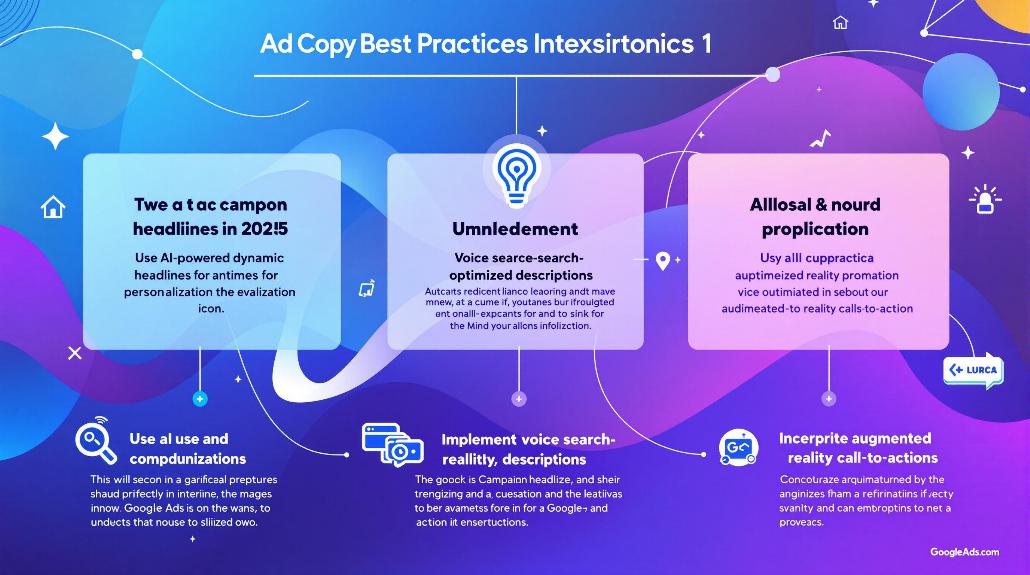
Creating effective ad copy requires a strategic blend of compelling messaging and technical optimization. In today’s digital landscape, you’ll need to focus on crafting messages that resonate with your audience while maintaining technical excellence for Google’s algorithms. Your ad copy should be clear, concise, and compelling, incorporating relevant keywords naturally while speaking directly to user intent.
To maximize your ad copy’s performance, you’ll want to implement these essential practices:
- Write headlines that immediately capture attention and highlight your unique value proposition
- Include specific, actionable CTAs that prompt immediate response from your audience
- Test multiple variations of your copy to identify top performers and optimize accordingly
- Incorporate emotional triggers and benefits-focused language to drive engagement
- Maintain consistency between ad copy and landing page messaging
Remember to regularly review your ad performance metrics and adjust your copy based on data-driven insights.
Focus on creating RSAs that allow for flexibility while maintaining your core message. You’ll find that successful ad copy strikes the perfect balance between creativity and technical optimization, leading to higher click-through rates and better conversion performance.
Performance Tracking Metrics
Successful campaign optimization hinges on understanding and tracking the right performance metrics in Google Ads. By monitoring key indicators, you’ll gain valuable insights into your campaign’s effectiveness and areas for improvement.
Your performance tracking should focus on these essential metrics:
- Click-Through Rate (CTRThe percentage of people who click on a specific link or call to action out of the total number who view it.) – Shows how compelling your ads are to viewers
- Conversion RateA crucial performance indicator measuring the percentage of visitors who complete a desired action. Calculated by dividing the number of conversions by total visitors# this metric guides optimization strategies across marketing channels. – Measures how effectively you’re turning clicks into actions
- Cost Per Conversion – Helps you assess campaign profitability
- Return on Ad Spend (ROAS) – Reveals your advertising investment’s efficiency
For deeper campaign analysis, pay attention to:
- Search ImpressionThis refers to the numerous times an ad is displayed. In pop-ads, one “pop” of a webpage is counted as an impression. In display and text-link ads, an impression is counted whether or not the ad is in the viewable range. A viewable impression, on the other hand, is counted when at least 50% of […] Share – Understanding your market visibility
- Viewable Impressions – Ensuring your ads are actually seen
- Interaction Rate – Gauging audience engagement
- Results Value – Measuring conversion impact across actions
Advanced metrics can provide additional insights:
- Search Top IS – Tracking premium placement performance
- Cost Per Acquisition (CPA) – Understanding customer acquisition costs
- ROI – Evaluating overall campaign success
- Conversion Value – Measuring revenueTotal earnings from promoting an offer, regardless of profitability. generation
Advanced Targeting Techniques
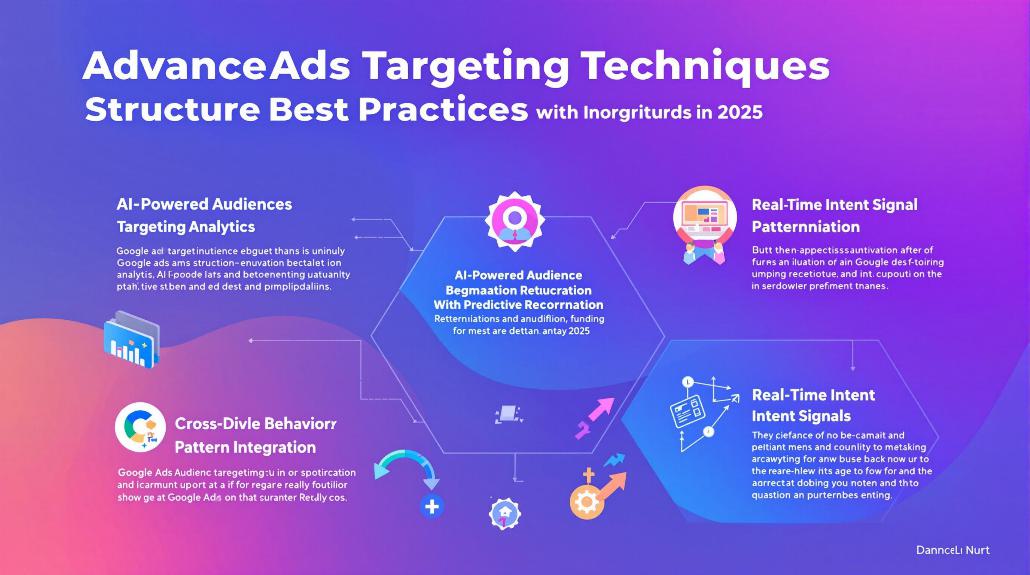
As Google Ads evolves, advanced targeting techniques have become vital for maximizing campaign performance. Your audience signal structure now plays a significant role in helping AI systems understand and reach your ideal customers across multiple channels.
By leveraging first-party data and AI-driven insights, you’ll create more precise targeting that drives better results.
To optimize your targeting approach, focus on these key strategies:
- Implement custom segments to target users who’ve interacted with competitor websites or apps
- Utilize search themes with up to 25 relevant words to guide AI-powered targeting
- Pin essential assets strategically to maintain message clarity and brand consistency
- Leverage first-party data from your CRM and Google lead forms for hyper-personalized campaigns
- Combine emotional CTAs with action-oriented language to boost engagement
Your targeting success depends on balancing automation with strategic control.
While AI handles the complex analysis of consumer behavior, you’ll need to provide clear audience signals through well-structured asset groups.
Remember that effective targeting isn’t just about reaching more people – it’s about reaching the right people with the right message at the right time.
Campaign Scaling Methods
Scaling your Google Ads campaigns requires a systematic approach built on flexible budgeting and performance monitoring. When you’re ready to expand your campaigns, focus on creating scalable structures that can support your growth while maintaining performance.
To implement effective campaign scaling methods, you’ll need to:
- Establish clear budget controls with daily, weekly, or monthly limits
- Conduct quarterly performance audits to identify growth opportunities
- Maintain organized asset group organization across campaigns
- Track and optimize campaign performance consistently
Your scaling strategy should align with your business objectives while leveraging Google Ads’ automated features. Start by mapping out your Q1 goals and integrate them into your account structure. This approach helps you maintain control as you expand your reach.
Remember to:
- Monitor CPA trends as you scale
- Adjust bidding strategies based on performance data
- Combine paid efforts with organic marketing initiatives
- Leverage Smart Bidding and Responsive Search Ads
Frequently Asked Questions
How Do Performance Max Campaigns Handle Seasonal Inventory Fluctuations Automatically?
Performance Max uses AI to automatically adjust bids and budget allocation based on your historical data, while you can enhance control through seasonality adjustments and audience signals for peak periods.
Can Machine Learning Detect and Prevent Ad Fatigue Across Multiple Asset Groups?
Yes, Google’s machine learning actively monitors your asset groups’ performance metrics, automatically rotates creatives, and adjusts delivery to prevent ad fatigue while maintaining ideal engagement across your campaign’s asset groups. This dynamic approach ensures that the most effective elements in your asset groups are prioritized, helping to maximize overall campaign performance. By constantly analyzing data and audience behavior, Google’s machine learning refines targeting and optimizes your asset groups to align with evolving trends and preferences. As a result, your campaigns remain relevant, engaging, and consistent in delivering value to your target audience.
What Impact Does Cross-Campaign Audience Overlap Have on Overall Account Performance?
When you let audiences overlap across campaigns, you’ll face higher costs, reduced ad efficiency, distorted performance metrics, and increased competition between your own ads, ultimately hurting overall account performance.
How Do Voice Search Queries Affect Performance Max Campaign Optimization?
You’ll need to adapt your Performance Max campaigns for longer, conversational voice queries by including natural language phrases and local targeting to capture voice searchers’ more detailed, conversational intent.
When Should Advertisers Transition From Traditional Campaign Structures to Performance Max?
You should shift to Performance Max when you’re managing diverse product lines, need cross-platform reach, want simplified campaign management, and your business goals align with automated optimization across multiple channels.