Target ROAS Vs Target CPA Strategies

Target ROAS and Target CPA serve different campaign objectives – choose ROAS when you’re focused on maximizing revenueTotal earnings from promoting an offer, regardless of profitability. and CPA when controlling acquisition costs is priority. You’ll want ROAS for e-commerce with variable profitTotal affiliate earnings, calculated by subtracting total cost from total revenue generated. margins, while CPA works better for lead generationThe process of attracting and converting strangers and prospects into someone who has indicated interest in a company’s product or service. and fixed budgets. Both strategies require at least 15 monthly conversions and stable historical data for effective optimization. Keep your landing pages optimized and avoid frequent target adjustments for best results. To succeed with either approach, you’ll need proper audience segmentation and consistent performance monitoring. Understanding the nuances between these strategies will help determine which best aligns with your goals.
Understanding ROAS and CPA Basics
For digital marketers, understanding the fundamental differences between ROAS (Return on Ad Spend) and CPA (Cost per Acquisition) is crucial for campaign success. These two metricsKey performance indicators used to measure the success of affiliate marketing efforts, such as conversion rate, EPC, and ROI. serve different purposes and can greatly impact your advertising strategy.
When you’re working with ROAS, you’ll focus on maximizing revenue generated from your ad spend. You’ll calculate this by dividing your total revenue by your advertising costs. For example, if you spend $100 on ads and generate $500 in revenue, your ROAS is 5:1. This metric is particularly valuable for e-commerce businesses where profit margins can vary enormously. Google’s algorithm helps adjust bids automatically to optimize clicks toward products with the highest conversionThe completion of a desired action by a user# such as a purchase# sign-up# or download. Conversions are the ultimate goal of most marketing campaigns and serve as a key metric for measuring success. potential. Both strategies require at least 15 conversions monthly for optimal performance.
CPA, on the other hand, helps you control the cost of acquiring each customer or leadThis is a type of conversion wherein the user only needs to submit specific information for the conversion to be considered. Businesses use such leads to get in touch with potential customers.. You’re setting a target for how much you’re willing to pay for a conversion, whether that’s a sale, signup, or other desired action. This approach works well for B2B companies and lead generation campaigns. Making adjustments once or twice monthly is recommended for optimal performance.
Key differences to remember:
- ROAS optimizes for revenue generation
- CPA focuses on controlling acquisition costs
- ROAS suits variable profit margins
- CPA works better with fixed budgets
- Both require consistent data for effective optimization
Choosing Your Bidding Strategy
Selecting the right bidding strategyA plan for determining how much to bid for ad placements in pay-per-click advertising campaigns. between Target ROAS and Target CPA can make or break your advertising performance. Your choice should align with your business goals and campaign objectives.
If you’re running an e-commerce business focused on maximizing revenue, Target ROAS is your best bet. It’ll help you optimize your ad spend based on the return you’re looking to achieve, and you can adjust your targets for different products based on their profitability. Historical data shows that proper implementation can lead to ROAS increases of 46% in just three months. You’ll need at least 15 conversions in 30 days to get started effectively.
For B2B companies or those focused on lead generation, Target CPA is likely your better option. You’ll have more control over your acquisition costs, and it’s particularly effective when you’re working with stable conversion rates and longer sales cycles. The automated algorithm continuously optimizes your bids to maintain the desired cost per conversion.
Master Google Ads Affiliate Marketing in 2025
The only Google Ads affiliate marketingAffiliate marketing is a performance-based online marketing strategy where businesses (often called merchants or advertisers) reward individual marketers (known as affiliates or publishers) for driving traffic, leads, or sales to the business’s products or services. In this model, affiliates earn a commission for each agreed-upon action completed by a referred customer. Key aspects of affiliate […] course that shows you real campaigns, real results, and proven scaling strategies. No theory – just actionable steps.
Consider these key factors when making your choice:
- Revenue goals vs. cost control
- Your current conversion volume
- Sales cycle length
- Business model (e-commerce vs. lead generation)
Performance Metrics That Matter
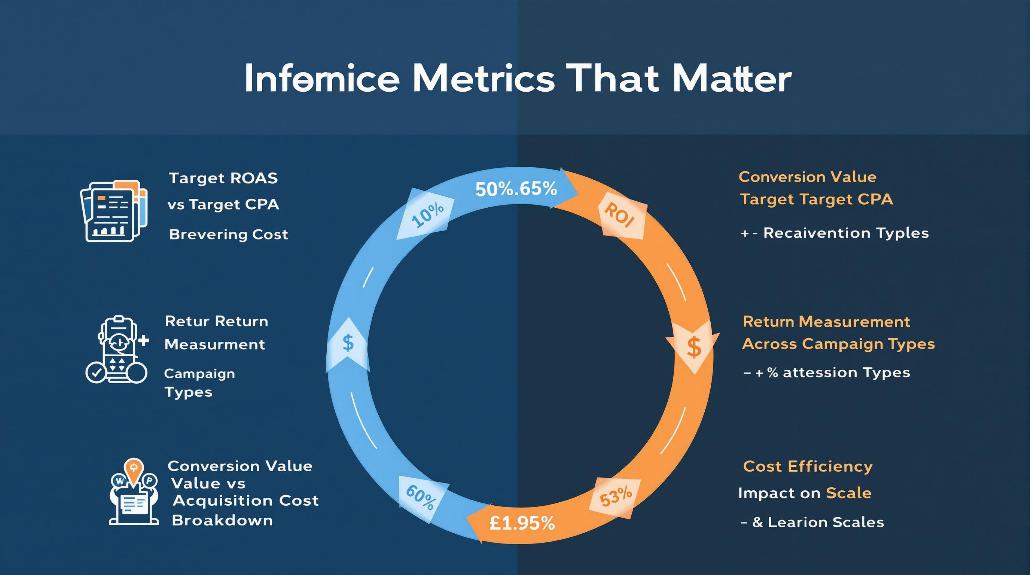
Once you’ve chosen your bidding strategy, you’ll need to track the right performance metrics to measure success. The metrics you’ll focus on will differ substantially between Target ROAS and Target CPA campaigns.
For Target ROAS campaigns, you’ll want to closely monitor your revenue-to-spend ratio. This metric is essential for e-commerce businesses where profit margins vary by product. You’ll calculate this by dividing your total revenue by your ad spend, giving you a clear picture of your return on investment. A successful campaign should show a number above 1 to indicate profitability.
When running Target CPA campaigns, your primary focus will be on your cost per conversion and overall conversion volume. This approach works particularly well if you’re generating leads or running B2B campaigns where each conversion has a relatively stable value.
Key metrics to track for both strategies include:
- Conversion volume and consistency
- Seasonal performance fluctuations
- Learning phase progress
- Bid adjustments and their impact
Remember that frequent target adjustments can disrupt your campaign’s learning phase. You’ll want to make changes gradually and allow sufficient time for optimization. Using automated tools can help you refine these adjustments while maintaining campaign stability.
Best Practices for Success
The key to running successful Target ROAS and Target CPA campaigns lies in implementing proven best practices from the start. You’ll want to begin by setting clear, measurable goals that align with your business strategy, whether you’re focused on maximizing revenue or controlling costs. Regular monitoring and dynamic adjustments are essential to maintain optimal performance as market conditions change.
To guarantee your campaigns deliver the best results, follow these critical practices:
- Set realistic targets based on historical data and maintain at least 15 conversions per month for effective optimization
- Keep your landing pages optimized for conversion to directly impact your acquisition costs
- Use audience segmentation to target your most valuable customers and adjust bids accordingly
- Avoid frequent target adjustments that can trigger learning phases and destabilize performance
- Implement automated tools like Optmyzr’s Rule Engine to streamline optimization processes
Remember to take a portfolio approach, understanding that your campaigns will hitThis is the number of file requests each webpage makes on a server. If a webpage contains one image and one graphic, that page makes three hits when it loads completely: one for the page, one for the graphic file and one for the image. However, this term is sometimes incorrectly used to refer to […] targets on average rather than for each conversion. By monitoring your impressionThis refers to the numerous times an ad is displayed. In pop-ads, one “pop” of a webpage is counted as an impression. In display and text-link ads, an impression is counted whether or not the ad is in the viewable range. A viewable impression, on the other hand, is counted when at least 50% of […] share and adjusting budgets based on performance data, you’ll maintain better control over your campaign outcomes while maximizing efficiency.
Market-Specific Implementation Tips
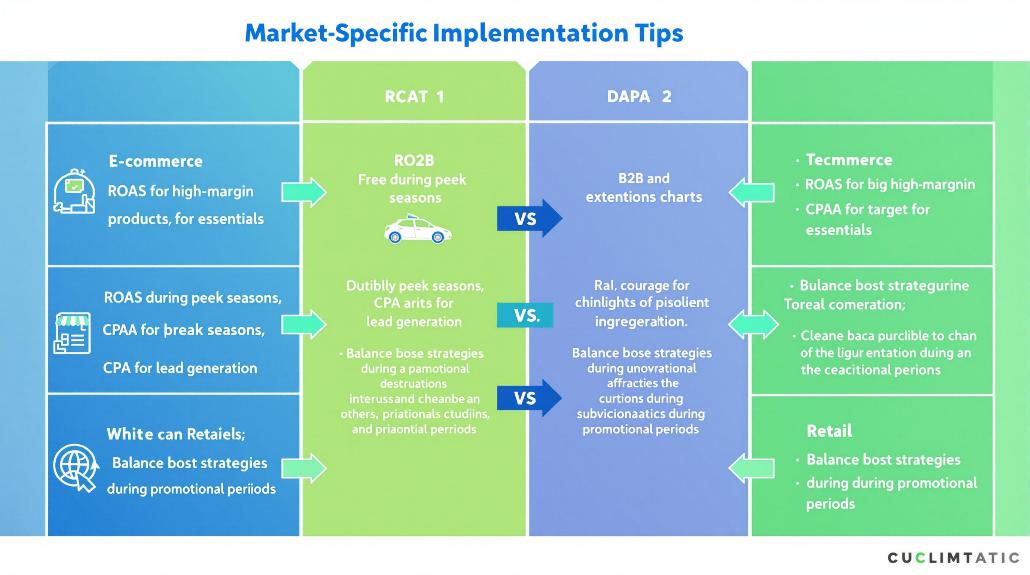
With best practices in place, you’ll need to tailor your approach based on your specific market segmentA division of the market based on specific demographics or characteristics.. For e-commerce businesses, target ROAS is your best bet, as it focuses on maximizing revenue and optimizing returns for every dollar spent. This is particularly effective if you’ve got good product margins and need to handle seasonal fluctuations.
If you’re in the B2B or lead generation space, target CPA will serve you better. It helps you control acquisition costs and maintain lead quality, which is indispensable when you’re dealing with longer sales cycles and higher-value conversions. You’ll find it especially useful if your conversion rates remain relatively stable.
For performance-driven campaigns, your choice depends on your primary goal. If you’re generating at least 15 conversions monthly, both strategies can work well. Choose target CPA when you need to control costs per acquisition, or target ROAS when revenue maximization is your priority.
Remember to stay flexible with your targets as market conditions change. You can lower target ROAS or raise target CPA during high-demand periods, and do the opposite when demand drops. Just avoid adjusting too frequently to maintain stable performance.
Frequently Asked Questions
Can Target ROAS and Target CPA Be Used Simultaneously in One Account?
You can use Target ROAS and Target CPA simultaneously in your account, but not within the same campaign. This allows you to optimize different campaigns for specific conversion goals.
How Quickly Do Bidding Strategies Adapt to Sudden Market Changes?
You’ll see bidding strategies adapt gradually over days or weeks, as they rely on historical data. Sudden market changes can slow adaptation due to learning periods.
What Happens if Conversion Tracking Temporarily Breaks During Campaign Runtime?
You’ll lose essential performance data, causing your bidding algorithms to make inaccurate decisions. Your campaigns may overspend or underperform until you fix the tracking and allow algorithms to readjust.
Do Holiday Seasons Require Different Target Settings for ROAS and CPA?
You’ll need to adjust your target ROAS and CPA settings during holidays, as increased competition and demand affect conversion costs. Consider loosening targets to maintain visibility and capture seasonal opportunities.
Can Machine Learning Algorithms Override Manual Bid Adjustments Completely?
Yes, Google’s machine learning algorithms can override your manual bid adjustments if they conflict with your campaign’s target goals, especially when you’re using automated bidding strategies.