Google Ads Popular Bidding Strategies

Google Ads offers several popular bidding strategies to match your advertising goals. You’ll find Manual CPC provides complete control over your maximum bids, while Smart Bidding uses machine learning to optimize automatically. For lead generationThe process of attracting and converting strangers and prospects into someone who has indicated interest in a company’s product or service., Target CPA can deliver 21% more conversions than manual bidding. If you’re running an e-commerce store, ROAS bidding helps maximize return on ad spend by targeting high-value customers. Maximize Clicks works well for new campaigns and keywordThis is the term or phrase that users utilize to search for anything on the internet. This can also be the term focused on by SEO experts to drive organic traffic to their website. testing, while CPM suits brand awareness goals through impressionThis refers to the numerous times an ad is displayed. In pop-ads, one “pop” of a webpage is counted as an impression. In display and text-link ads, an impression is counted whether or not the ad is in the viewable range. A viewable impression, on the other hand, is counted when at least 50% of […]-based bidding. Understanding each strategy’s strengths will help you make the most of your advertising budget.
Understanding Google Ads Bidding
Google’s advertising platform operates on a sophisticated auction system where multiple advertisers compete for valuable ad placements across the search network. When you participate in these auctions, your success depends on multiple factors beyond just your bid amount, including your ad’s quality score and relevance to the target audience. Higher bids generally improve your chances of securing premium ad positions.
You’ll find that smart bidding has revolutionized how advertisers approach these auctions. Using machine learning, automated bidding strategies can now optimize your bids in real-time based on various signals like device type, location, and user behavior. You’re able to maintain control over your budget while letting Google’s algorithms work to achieve your specific campaign goals. Whether you’re aiming for more conversions or better ROAS, there’s a bidding strategyA plan for determining how much to bid for ad placements in pay-per-click advertising campaigns. that aligns with your objectives. These strategies provide flexibility to focus on either new customer acquisition or retargeting campaigns with separate bidding approaches.
Manual CPC Vs Smart Bidding
The fundamental choice between Manual CPC and Smart Bidding represents a critical decision point for advertisers managing Google Ads campaigns. Each strategy offers distinct advantages that can profoundly impact your advertising success.
With manual CPC, you’ll have complete control over your maximum cost-per-click bids at the keyword, ad group, and product group levels. You can make immediate adjustments based on performance, though this approach requires more time and expertise to manage effectively. Two out of five small to medium-sized businesses choose pay-per-click advertising. Brand or competitor campaigns may benefit from Manual CPC control.
Smart bidding, on the other hand, leverages machine learning to optimize your bids automatically. It processes millions of signals and metricsKey performance indicators used to measure the success of affiliate marketing efforts, such as conversion rate, EPC, and ROI. that aren’t available with manual bidding, making it particularly effective for large campaigns. While you’ll sacrifice some control, you’ll gain efficiency and access to powerful automation that can help achieve specific goals like maximizing conversions or maintaining target ROAS.
Maximize Clicks Strategy
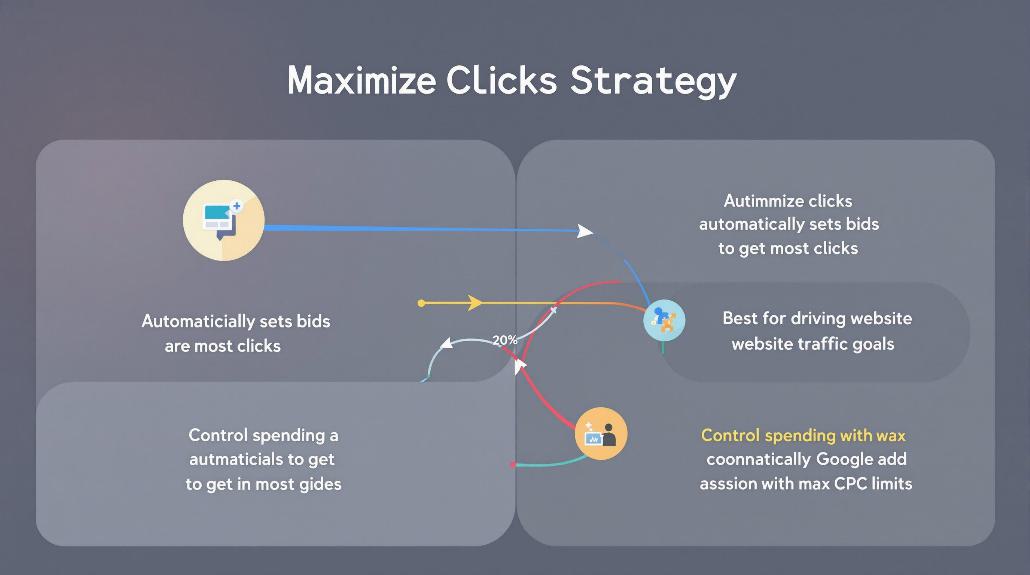
Moving beyond manual controls, Maximize Clicks stands as one of Google Ads’ most straightforward automated bidding strategies. It’s designed to get you the highest possible number of clicks within your specified budget through intelligent budget optimization and real-time bid adjustments. The system readjusts bids automatically based on keyword competition levels.
When you’re starting a new campaign or testing keywords, this strategy proves particularly valuable. Google’s advanced machine learning continuously works to identify the best opportunities for your ads. You won’t need to manage individual bids manually – the system automatically adjusts them based on various factors like ad quality and competition.
While you can set a maximum CPC limit to control costs, the strategy focuses on maximizing your ad’s visibility and click volume.
Remember that while Maximize Clicks excels at driving trafficThis is the inflow of visitors to a page., it doesn’t guarantee conversionThe completion of a desired action by a user# such as a purchase# sign-up# or download. Conversions are the ultimate goal of most marketing campaigns and serve as a key metric for measuring success. quality. It’s best suited for brand awareness campaigns or when you’re building initial campaign data.
Target CPA For Lead Generation
Implementing Target CPA (Cost Per Acquisition) stands as a powerful automated bidding strategy for advertisers focused on leadThis is a type of conversion wherein the user only needs to submit specific information for the conversion to be considered. Businesses use such leads to get in touch with potential customers. generation. This strategy leverages Google’s machine learning to automatically adjust your bids in real-time, aiming to get you the most conversions at your specified target CPA.
To make target CPA work effectively, you’ll need proper conversion trackingThe process of measuring and analyzing how many visitors to a website complete a desired action, such as making a purchase or signing up for a newsletter. set up and enough historical data for the algorithm to learn from. The system typically needs 7-14 days to optimize your campaign performance. During this learning phase, it’s key to avoid making major changes that could disrupt the optimization process. You can implement this strategy across multiple campaigns to maximize its effectiveness. Advertisers can expect 21% more conversions compared to manual bidding when implementing Target CPA correctly.
For best results, confirm your campaign budgets are at least 10 times your target CPA, group similar-performing keywords together, and avoid setting restrictive bid limits that could hamper the algorithm’s effectiveness.
ROAS Bidding For E-commerce
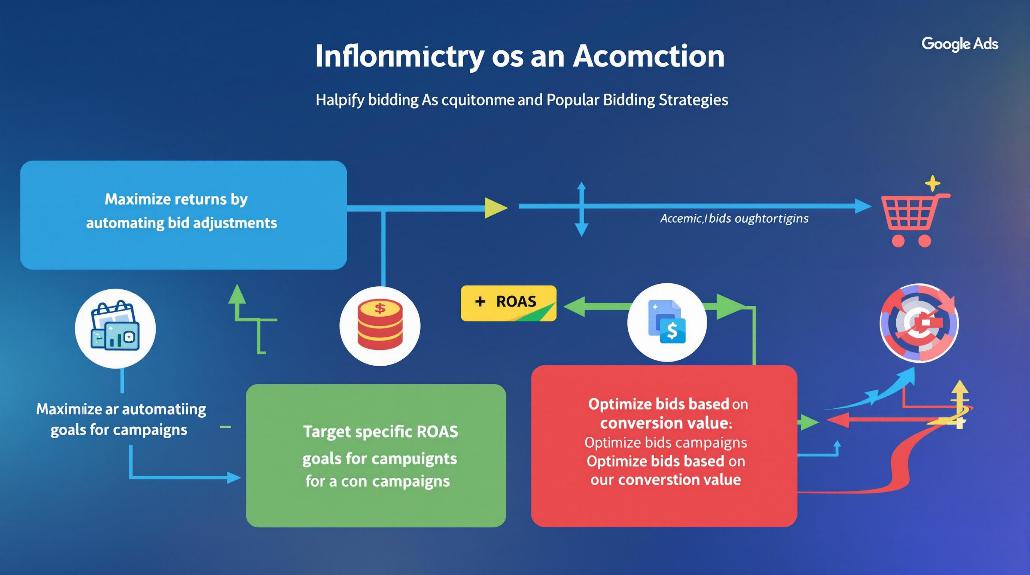
Within the domain of e-commerce advertising, ROAS (Return on Ad Spend) bidding serves as a strategic cornerstone for maximizing revenueTotal earnings from promoting an offer, regardless of profitability. from your ad campaigns. This smart bidding strategy uses Google’s AI to automatically adjust your bids based on the likelihood of generating sales at your target ROAS. The system continuously learns and refines the strategy to enhance overall performance. Companies like Hepsiburada have achieved 104% increase in campaign earnings using this approach.
To implement this strategy effectively, you’ll need accurate conversion tracking and substantial historical data. Set your target ROAS by calculating your desired revenue-to-spend ratio, such as 500% for $5 in revenue per $1 spent.
While managing your campaigns, focus on ROIReturn on Investment, a key performance indicator calculated as a percentage by dividing profit by cost and multiplying by 100. optimization by:
- Creating separate campaigns for different product categories
- Monitoring performance regularly
- Optimizing product listings
- Avoiding overly broad targeting
You’ll benefit from automated bid management and precise targeting, allowing you to focus on high-value customers while maintaining profitable ad spend levels.
CPM For Brand Awareness
CPM (Cost Per Mille) bidding stands out as a strategic choice when your primary goal is to boost brand awareness through maximum ad visibility. You’ll pay for every 1,000 impressions your ad receives, making it ideal for reaching a broad audience quickly.
While this strategy excels at increasing brand visibility, you’ll need to monitor cost efficiency carefully. Since you’re paying for impressions regardless of user interaction, it’s essential to set clear objectives and budget limitations.
This bidding method is now primarily available for YouTube campaigns, where it’s particularly effective for video content.
To make the most of CPM bidding, focus on creating compelling visual ads that capture attention quickly. Remember, you’re aiming for widespread exposure rather than immediate conversions, so measure success through metrics like reach and frequency rather than direct response rates.
Video Campaign Bidding Options
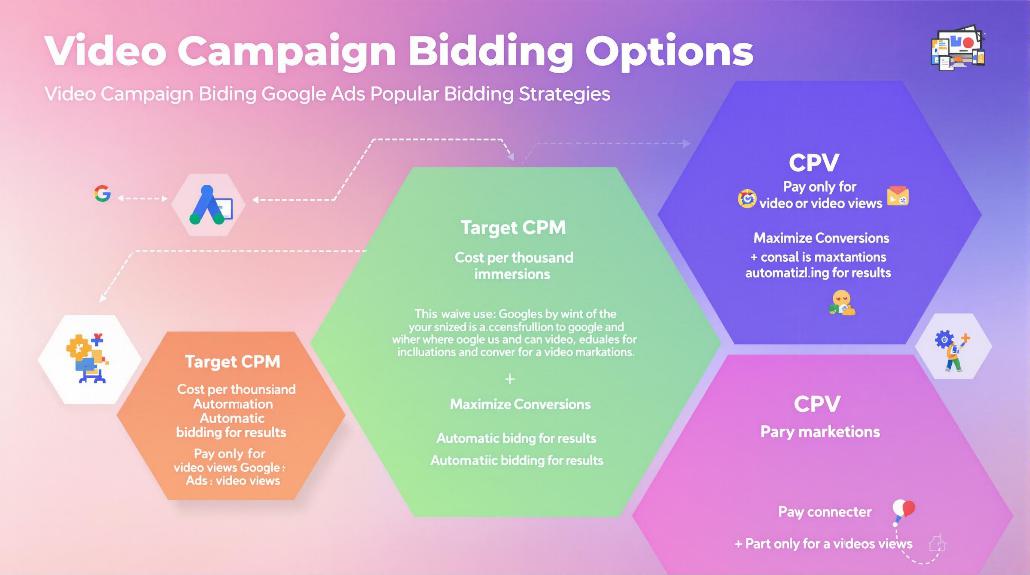
Several powerful bidding options exist for video campaigns on Google Ads, with CPV (Cost-per-view) standing out as the primary choice for advertisers. With CPV, you’ll only pay when viewers watch at least 30 seconds of your video or interact with it through clicks on overlays and companion banners.
The system leverages auction-time bidding and real-time optimization to guarantee your ads reach engaged viewers. You can set specific targeting parameters, including demographics and interests, while maintaining control over your daily budgetThe maximum amount an advertiser is willing to spend per day on a specific campaign or ad set. This budgeting tool helps control advertising costs and paces campaign spending over time. at the campaign level. This approach is particularly effective when you’re aiming to maximize video views and engagement.
For best results, you should:
- Define clear campaign objectives
- Monitor performance regularly
- Adjust bids based on viewer engagement
- Focus on popular YouTube placements
- Implement targeted bidding strategies
Conversion Value Optimization Strategies
To maximize the return on your advertising investment, conversion value optimization strategies enable you to focus on acquiring the most valuable customers rather than simply accumulating conversions. By implementing value-based bidding, you’ll leverage Google’s machine learning to target users more likely to complete high-value transactions.
When choosing between bidding strategies, you’ll find that maximize conversion value focuses on driving the highest total conversion value within your budget. If you need more control, target ROAS allows you to set specific return goals while still optimizing for value.
For success with these strategies, you’ll need:
- Accurate conversion tracking setup
- Transaction-specific values assigned to conversions
- Regular monitoring and optimization
- Sufficient historical data for algorithm learning
These approaches work best when you’re selling products with varying values or targeting customers with different lifetime values.
Smart Bidding Success Factors
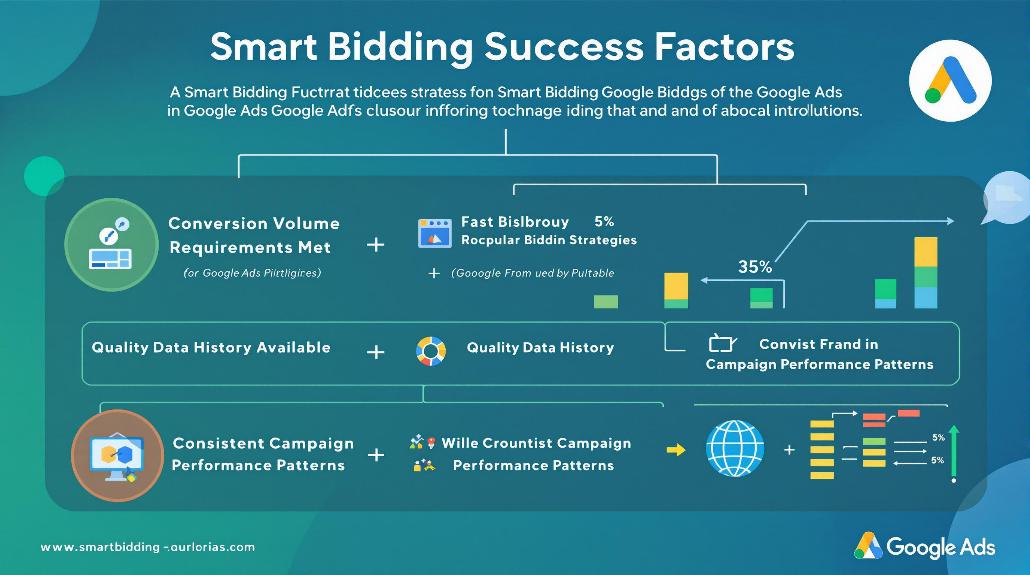
While Smart Bidding has revolutionized Google Ads management, achieving ideal results requires specific conditions and practices. Your success depends on implementing the right foundation and maintaining proper oversight of your campaigns.
To maximize Smart Bidding’s effectiveness, you’ll need:
- Sufficient conversion data for accurate bid optimization
- Clear conversion tracking setup
- Realistic performance targets
- Regular performance monitoring and adjustments
- Removal of manual bid constraints
Don’t rush to switch strategies if you’re not seeing immediate results. Smart Bidding’s machine learning algorithms need time to gather data and optimize effectively. You’ll also want to guarantee you’re leveraging all available contextual signals, including device, location, and time of day data. These signals help the system make more informed bidding decisions for each auction.
Frequently Asked Questions
How Long Does It Take for Smart Bidding to Gather Enough Data?
You’ll need to wait around 7-10 days for Smart Bidding to collect enough data, though this can vary based on your conversion volume and campaign complexity.
Can Different Bidding Strategies Be Used Within the Same Google Ads Account?
Yes, you can use multiple bidding strategies within your Google Ads account. You’ll have the flexibility to apply different strategies across campaigns, ad groups, and keywords to match specific objectives.
What Happens to Bidding Strategies During Seasonal Business Fluctuations?
You’ll need to adjust your bidding strategies during seasonal fluctuations, using seasonality adjustments to inform Smart Bidding of expected conversion rateA crucial performance indicator measuring the percentage of visitors who complete a desired action. Calculated by dividing the number of conversions by total visitors# this metric guides optimization strategies across marketing channels. changes during events like holidays or promotions.
How Often Should Bidding Strategies Be Reviewed and Adjusted?
You’ll want to review your bidding strategies daily for high-budget campaigns, weekly for standard campaigns, and at least monthly to track trends and make necessary adjustments for ideal performance.
Can Bid Adjustments Still Be Applied When Using Automated Bidding Strategies?
You can’t apply most bid adjustments with automated bidding strategies, except for Enhanced CPC, which allows manual adjustments alongside Google’s automated optimization to fine-tune your campaign performance.
2025’s #1 Google Ads Affiliate Marketing Course [Limited Time Offer]
Learn the exact Google Ads strategies that generated $7M in affiliate commissions. Includes real campaign examples, templates, and bonus 30-Day Challenge course.